Human phenomics is the systematic measurement and analysis of the human phenotype across many biological scales. The phenome is the full set of phenotypic characteristics expressed by an individual across anatomy, physiology, molecular state, behavior, and time. Houle, Govindaraju and Omholt framed phenomics as organism-wide acquisition of high-dimensional phenotypic data and argued that phenomic measurement should develop alongside genomics.1
A genome provides essential biological information, yet it cannot describe an adult person by itself. Two people can share extremely similar genomes and still differ in anatomy, health, metabolism, immune history, behavior, learned abilities, and disease risk. Human phenomics measures the realized organism across these additional layers.
What is a phenotype?
A phenotype is any observable or measurable characteristic of an organism. The term can describe a visible trait such as height or facial morphology, a physiological quantity such as blood pressure, a molecular feature such as a metabolite concentration, or a clinical manifestation such as an abnormal heart rhythm.
Phenotypes exist at many scales and change at different speeds. Skeletal proportions can remain relatively stable in adulthood. Blood glucose can change within minutes. Immune states can shift after infection or vaccination. Gene expression varies by tissue, cell type, developmental stage, circadian phase, disease state, and environment.
The human phenome is therefore better understood as a multidimensional trajectory than as a static list of traits.
From genomics to phenomics
Genomics made genome-scale measurement routine. Longitudinal phenomics extends high-dimensional measurement to the changing state of the organism. A 2024 perspective in Nature Reviews Genetics describes repeated molecular, microbiome, lifestyle, behavioral, and clinical measurements as a way to follow individual health trajectories over time.2
Many biological outcomes emerge from interactions among genetic variation, regulatory systems, development, environment, and history. Genotype–phenotype mapping seeks the mechanisms that connect these layers. Phenomics supplies the high-dimensional observations required to study those mechanisms.
Major domains of the human phenotype
A phenomics program also records exposures, microbiome measurements, and life history that explain or modify phenotype without becoming phenotypic traits by definition.
| Layer | Examples | Typical measurement sources |
|---|---|---|
| External morphology | Facial geometry, body proportions, pigmentation, hair, posture | Photography, video, 3D scanning, anthropometry |
| Internal anatomy | Organ dimensions, tissue structure, vascular anatomy, body composition | MRI, CT, ultrasound, microscopy |
| Physiology | Heart rate, blood pressure, respiration, glucose dynamics, sleep | Clinical tests, wearables, continuous monitoring |
| Molecular phenotype | Proteins, metabolites, transcripts, immune markers | Proteomics, metabolomics, transcriptomics, immunophenotyping |
| Cellular phenotype | Cell types, states, morphology, signaling responses | Single-cell assays, imaging, flow cytometry, spatial methods |
| Host-associated microbiome context | Microbial composition and function | Metagenomics and related assays |
| Behavior and performance | Movement, speech, reaction patterns, motor skills, activity | Video, audio, sensors, task-based testing |
| Clinical phenotype | Symptoms, diagnoses, laboratory abnormalities, treatment response | Medical records and standardized clinical assessment |
| Exposures and longitudinal context | Diet, environmental exposure, lifestyle, medication, disease history | Questionnaires, records, environmental sensors, longitudinal observation |
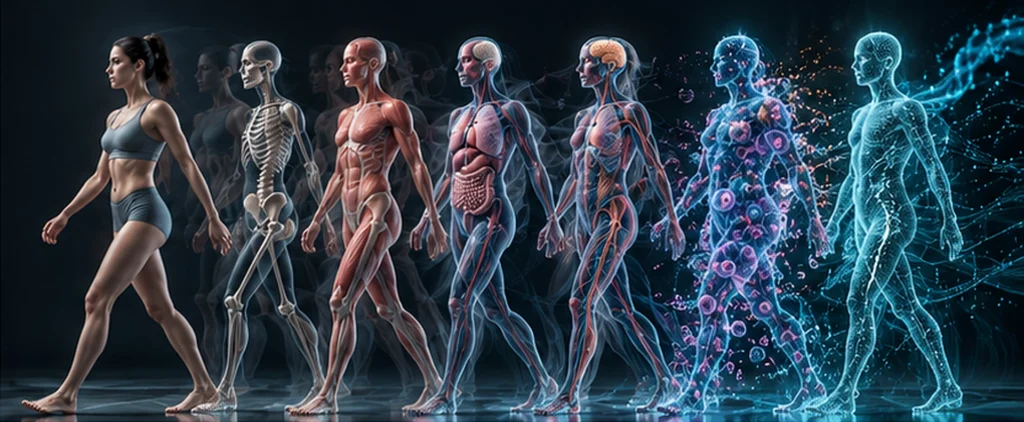
Deep phenotyping and standardized descriptions
Deep phenotyping is the precise and comprehensive description of the individual components of a phenotype. Robinson’s foundational account connected deep phenotyping with computational resources that can capture, exchange, and integrate phenotype data with genomic and clinical information.3
The Human Phenotype Ontology provides a standardized vocabulary for phenotypic abnormalities. Its 2024 reference publication describes HPO as a globally recognized standard for computational encoding of deep phenotype data and documents its use in genomic diagnostics, gene–disease discovery, and cohort analysis.4
Standardization allows observations from different people, laboratories, devices, and time points to remain comparable. A useful phenomic representation needs explicit definitions, measurement units, uncertainty, provenance, and temporal context. Ordinary human variation adds continuous measurements, dynamic responses, anatomical geometry, molecular profiles, and behavior to the same representational problem.
What a video can measure
Video is an unusually information-rich phenotype source because it records appearance and change together. Depending on image quality, camera geometry, duration, and context, footage can support measurements of facial structure, body proportions, posture, gait, movement patterns, facial expression, visible skin and hair characteristics, and aspects of behavior. An audio track can add voice, speech rhythm, and other acoustic features.
Markerless pose-estimation research shows that digital video can support automated tracking of anatomical landmarks and quantitative movement analysis. Reviews of markerless motion capture also document practical limits in joint-center estimation, camera geometry, clothing, occlusion, and validation against reference measurements.5 Digital phenotyping research extends continuous digital measurement to behavioral and physiological states captured through phones, sensors, and other devices.6
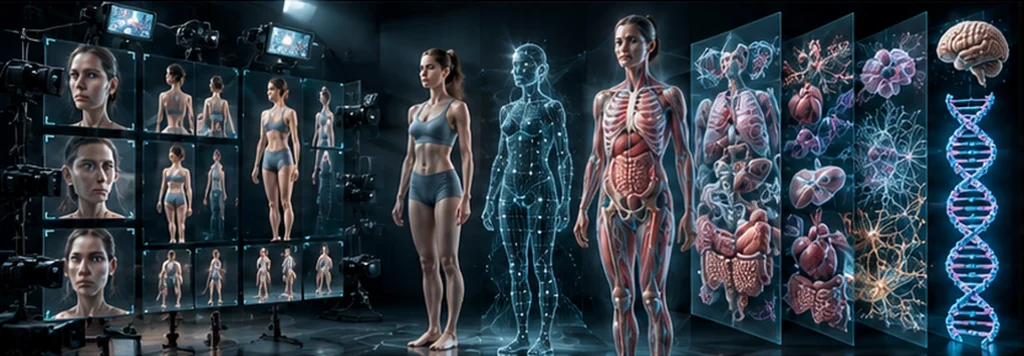
Repeated views improve geometric inference because the same structures appear from multiple angles. Motion creates additional constraints for estimating body shape and joint behavior. Long recordings can reveal patterns that a single photograph cannot capture.
These observations remain a partial phenotype. A conventional video does not reveal genome sequence, blood chemistry, organ structure, immune state, most cell types, endocrine regulation, microbiome composition, or detailed neural connectivity. Many visible traits also have multiple possible biological causes.
Phenotype inference is different from phenotype measurement
Direct measurement and statistical inference carry different evidentiary status. A calibrated imaging system can measure image geometry and color values under controlled acquisition conditions. The same footage might support a statistical estimate of age, body composition, or health status, with uncertainty that depends on the model and the population represented in its training data.
Each property should be labeled by evidence class: directly measured, derived from measured quantities, inferred statistically, supplied by another assay, or unknown.
A reconstruction system that treats uncertain predictions as exact biological facts would compound errors across later developmental stages. Measurement confidence therefore belongs inside the phenotype representation itself.
Longitudinal phenomics: a person changes over time
The Human Phenotype Project combines medical history, lifestyle and nutrition, anthropometrics, blood tests, continuous glucose and sleep monitoring, imaging, genetics, transcriptomics, microbiome measurements, metabolomics, and immune profiling. A 2025 Nature Medicine resource paper reports tens of thousands of enrolled participants and links repeated measurements with molecular signatures and predictive models across the health–disease continuum.7
A single snapshot cannot distinguish stable identity-linked traits from temporary biological states. Fever, pregnancy, training, medication, sleep deprivation, aging, injury, and disease can all alter measured phenotype.
A rigorous human phenome therefore needs time. Repeated measurements help estimate baseline states, rates of change, biological responses, and the range within which a person normally varies.
Connecting phenotype to genotype
Biobanks link genetic information with health records, biospecimens, measurements, surveys, and long-term outcomes, creating large datasets for genotype–phenotype mapping and precision medicine.8
Correlation alone cannot identify every mechanism required to reproduce a phenotype. A mechanistic reconstruction model needs to identify which mechanisms influence a trait, when they act during development, which tissues are involved, and how they interact with other pathways. The same adult phenotype can sometimes arise through different developmental routes.
Genetic information can constrain a biological specification, while observed phenotype records outcomes produced by development, physiology, environment, and history. The Molecular Mining analysis of human cloning and genome editing examines the genomic side of this problem.
Computable phenotypes
Ontologies, common data models, standardized units, anatomical coordinate systems, uncertainty estimates, and temporal labels make phenomic observations computable across datasets.
Cross-species phenotype frameworks extend this logic by connecting human and model-organism phenotype vocabularies. The Unified Phenotype Ontology provides a framework for integrative phenomics across species while preserving species-specific distinctions.9
Computability also requires missing information and contradictory observations to remain explicit. A useful representation should expose confidence and provenance for each property so that later models can distinguish measured states from inferred ones.
A phenotype is more than appearance
Two people can look alike while differing in internal anatomy, physiology, molecular state, immune function, and disease susceptibility. Visual resemblance therefore establishes only one dimension of phenotypic similarity; anatomical, physiological, molecular, and behavioral correspondence require their own measurements.
Human phenotype as a specification problem
Biological reconstruction turns phenomics into a specification problem: which properties must be captured to reproduce the target organism faithfully?
Phenomic data can be organized into five coupled biological domains and tracked through time:
- Visible specification: measurable external geometry, pigmentation, hair, movement, and voice.
- Anatomical specification: internal geometry, tissue composition, organ structure, and vascular organization.
- Physiological specification: dynamic functions such as metabolism, circulation, respiration, endocrine control, and immune response.
- Molecular specification: cell states, proteins, metabolites, gene expression, and epigenetic marks.
- Behavioral specification: learned motor patterns, speech, habits, task performance, and responses.
Time cuts across every domain. Genetic information, microbiome measurements, exposures, and life history constrain or explain these phenotypic states from outside the five-domain representation.
The same evidentiary rule applies throughout: each property remains marked as directly measured, derived, statistically inferred, supplied by another assay, or unknown. The broader biological reconstruction problem begins with that distinction.
References
- Houle D, Govindaraju DR, Omholt S. Phenomics: the next challenge. Nature Reviews Genetics. 2010.
- Yurkovich JT, et al. The transition from genomics to phenomics in personalized population health. Nature Reviews Genetics. 2024.
- Robinson PN. Deep phenotyping for precision medicine. Human Mutation. 2012.
- Gargano MA, et al. The Human Phenotype Ontology in 2024: phenotypes around the world. Nucleic Acids Research. 2024.
- Cronin NJ, et al. Applications of Pose Estimation in Human Health and Performance across the Lifespan. 2021.
- Zhang Y, et al. The comprehensive clinical benefits of digital phenotyping: from broad adoption to full impact. npj Digital Medicine. 2025.
- Reicher L, et al. Deep phenotyping of health–disease continuum in the Human Phenotype Project. Nature Medicine. 2025.
- Gallagher CS, Ginsburg GS, Musick A. Biobanking with genetics shapes precision medicine and global health. Nature Reviews Genetics. 2025.
- Unified Phenotype Ontology consortium. The Unified Phenotype Ontology: a framework for cross-species integrative phenomics. 2025.