
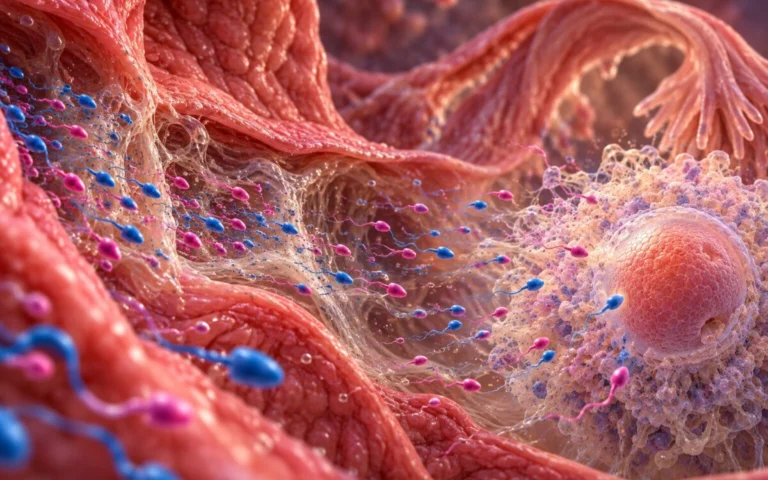
One man ejaculates first; a second man ejaculates into the vagina soon afterward. Their sperm can remain viable during overlapping intervals within one reproductive tract, pass through successive biological filters and, if two ova are released and independently fertilized, produce fraternal twins with different biological fathers.
The phenomenon is called heteropaternal superfecundation: two ova released during one ovulatory period are fertilized in separate events by sperm from different men. Human cases have been confirmed by forensic DNA testing, and recent reviews describe the phenomenon as rare and difficult to study directly.1, 2
What is heteropaternal superfecundation?
Superfecundation describes fertilization of two ova released during one ovulatory period through separate fertilization events. Heteropaternal superfecundation occurs when those ova are fertilized by sperm from different men. The resulting twins are dizygotic, or fraternal, and have different biological fathers.
The exact frequency is difficult to establish because the event is rare, most pregnancies are never tested for multiple paternity, and direct study of atypical human twinning is inherently limited. In a Colombian case published in 2020, autosomal STR and Y-STR testing established different paternity for a pair of male twins. One alleged father matched one twin with a reported probability of paternity of 99.9999%, while numerous genetic markers excluded him as the father of the other twin.3
Can a woman get pregnant by two men during one fertile window?
A heteropaternal twin pregnancy requires two ova and two independent fertilization events. One ovum can receive sperm from an earlier partner and the other can receive sperm from a later partner, provided sperm from both men remain viable at the relevant times.
Human sperm can enter cervical mucus rapidly after vaginal ejaculation. Classic human postcoital observations reported penetration into cervical mucus within minutes, while contemporary reviews emphasize how strongly transport depends on the female reproductive tract and how difficult natural human transport is to observe directly in vivo.4, 12 If the second ejaculation occurs soon enough, sperm from the first may already have entered cervical mucus before the second population is deposited.
Ejaculation order creates a temporal difference. It does not determine paternity by itself. Motility, survival, transport, timing relative to ovulation, capacitation, access to the oviduct and gamete interactions all contribute to the outcome.
What changes if the second ejaculation happens minutes, hours, or days later?
No human study has established an ideal gap between ejaculations from two different men for heteropaternal superfecundation. The interval changes which forms of cellular overlap are biologically plausible.
2–5 minutes. Progressively motile sperm from the first man may already be entering periovulatory cervical mucus; a human capacitation review cites migration into cervical mucus in about 90 seconds.14 If the second man ejaculates at this point, the later semen is deposited while some sperm from the first ejaculation have already left the vaginal pool and entered the cervical filter.
15–60 minutes. A classic review of human cervical mucus reported that sperm concentration in the mucus column is maximal from 15 minutes to 2 hours after vaginal deposition.15 At 15–30 minutes after the first ejaculation, sperm from the first man may already be distributed within cervical mucus when the second man ejaculates into the vagina. The second paternal population then enters while cells from the first are already moving through the cervical filter.
2–6 hours. The earlier population has had more time to redistribute and undergo selection. Direct overlap of seminal fluid lower in the tract becomes less informative; the biologically relevant overlap increasingly concerns surviving sperm cells from the two men occupying different parts of the reproductive tract.
12–24 hours. The two ejaculations are separated enough that lower-tract semen overlap becomes less central. The important question is whether sperm from the first man remain viable as sperm from the second man enter the tract.
48–72 hours and beyond. Overlap is primarily a question of sperm survival and timing relative to ovulation. In a prospective study of healthy women, conception occurred after intercourse within a six-day interval ending on the estimated day of ovulation. The observed probability of conception from intercourse on a single day ranged from 0.10 five days before ovulation to 0.33 on ovulation day.16 Those values describe conception timing in that cohort; they are not probabilities of heteropaternal superfecundation.
Is any interval ideal? Evidence does not identify an ideal gap between two men. For cervical occupancy, older human data place peak sperm concentration in cervical mucus within 15 minutes to 2 hours after vaginal deposition.15 For conception timing, the Wilcox cohort observed its highest single-day probability on the estimated day of ovulation.16 These are different biological endpoints and do not establish an optimal interval for two-father conception.
What happens when sperm from two men overlap during a fertile window?
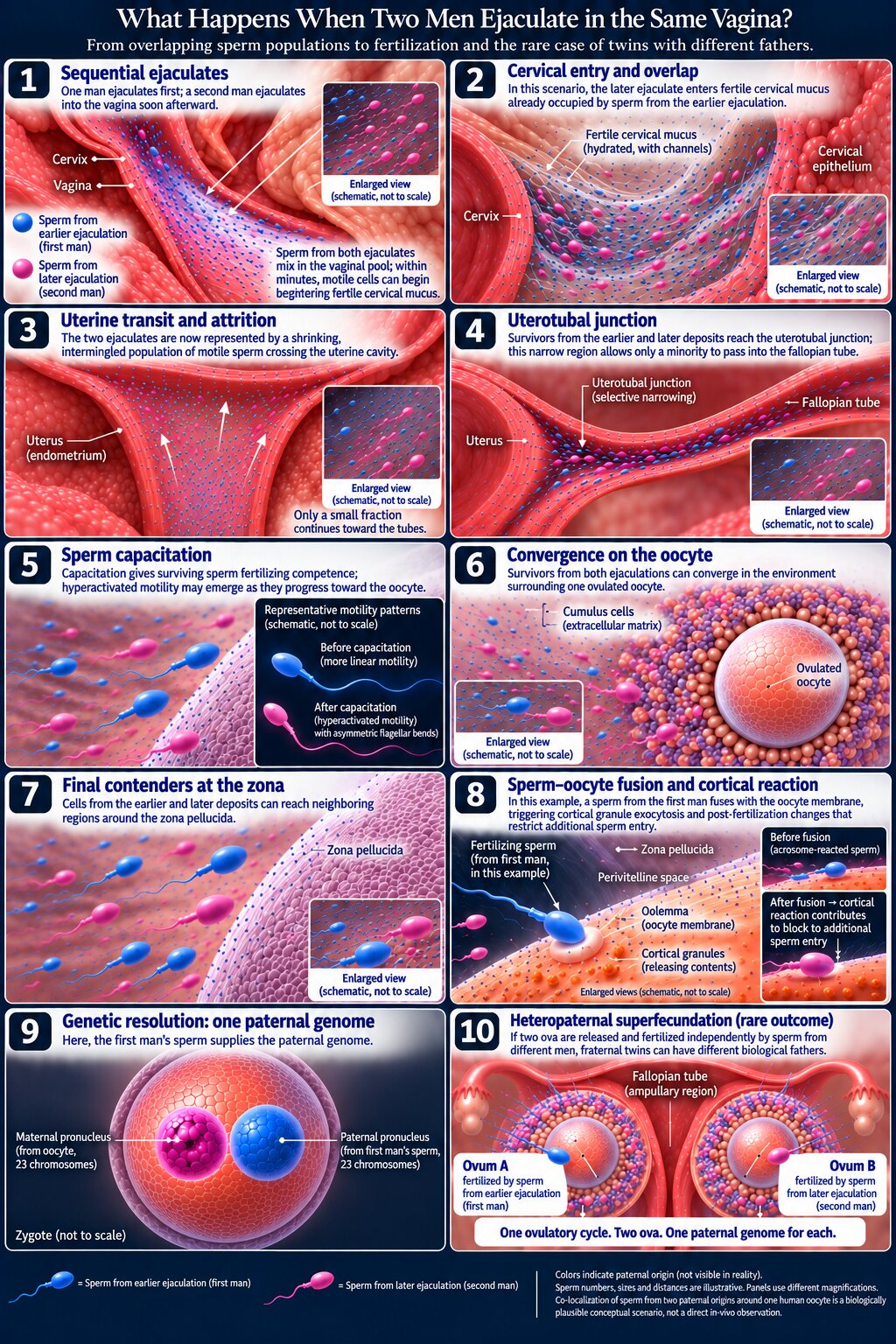
1. The first ejaculate starts moving before the second population arrives
After ejaculation, motile sperm begin dispersing from seminal plasma. Some cells remain in the vaginal pool, some are lost with fluid, and some move toward cervical mucus.
If the second ejaculation follows soon afterward, sperm from the first may already be inside cervical mucus while other cells from that ejaculate remain lower in the tract. Their genetic identities remain separate even when cells from the two ejaculates later occupy shared fluids and anatomical compartments.
2. The later population enters cervical mucus already occupied by earlier sperm
Around ovulation, cervical mucus becomes highly hydrated and more permissive to sperm transport. Its geometry, viscosity and interaction with motile cells affect which sperm enter the cervix and continue upward.
The later ejaculate can therefore encounter cervical mucus already containing cells from the earlier population. Paternal origin no longer corresponds to a separate anatomical lane. Cells from different ejaculates can become interspersed while remaining genetically distinct.
Earlier arrival does not guarantee later success. Sperm differ in progressive motility, morphology, membrane integrity and physiological state, while the female reproductive tract continuously filters the population.4, 12
3. Overlapping populations are reduced to sparse survivors upstream
An ejaculate can contain tens or hundreds of millions of sperm. Only a small fraction enters the cervix, and numbers fall dramatically during transport through the reproductive tract. Exact stage-by-stage counts in natural human conception remain uncertain because normal transport is difficult to observe directly in vivo.4, 12
With two ejaculates involved, severe attrition acts on both sperm populations. The overlapping populations are progressively reduced to sparse survivors farther upstream.
4. The uterotubal junction produces another severe narrowing
Sperm reaching the uterus still face a narrow transition before entering the fallopian tube. The uterotubal junction is an important selective passage in mammalian reproduction. Detailed human in-vivo mechanisms remain less completely resolved than those of experimentally studied mammals, so species boundaries matter when interpreting this literature.4, 12
5. Capacitation changes the surviving sperm
Ejaculated sperm require physiological remodeling before they acquire full fertilizing competence. During residence in the female reproductive tract they undergo capacitation, a collection of changes involving membrane properties, ion signaling, metabolism and protein phosphorylation.5, 13
Capacitation is associated with hyperactivated motility, in which flagellar beating becomes larger and more asymmetric. Sperm from the two ejaculates can overlap spatially while individual cells occupy different physiological states.
6. Surviving cells can converge in the environment surrounding one ovulated oocyte
The ovulated oocyte is surrounded by cumulus cells and extracellular matrix. Sperm approaching fertilization must navigate this cumulus–oocyte complex before reaching the zona pellucida.
If motile cells from both paternal origins survive during overlapping intervals, representatives of both populations could converge in the environment surrounding one oocyte.2, 4, 13
7. Cells from both populations could become locally interspersed in the cumulus–zona environment
The zona pellucida is the glycoprotein-rich extracellular coat surrounding the oocyte. Human zona pellucida contains ZP1, ZP2, ZP3 and ZP4, and several of these proteins participate in sperm binding and acrosomal physiology.6
Human fertilization research shows that acrosomal exocytosis has a more complex timing than older single-trigger diagrams suggest. Acrosome-reacted sperm can be present within the cumulus, and human zona proteins have distinct roles in sperm interaction.6, 13
If cells from both paternal origins reach this region, they could occupy neighboring positions while remaining genetically distinct.
8. One sperm reaches the oolemma and completes fusion
After traversing the zona pellucida, the fertilizing sperm enters the perivitelline space and reaches the oocyte plasma membrane, or oolemma. Successful fertilization requires molecular recognition and membrane fusion.
IZUMO1 on sperm and JUNO on the oocyte are central components of this recognition system. The IZUMO1–JUNO interaction is conserved across mammals, including humans; its discovery established a molecular receptor pair at the sperm–egg interface.7, 13 Either the earlier or later ejaculate could supply the sperm that completes fusion; sperm from the other man would contribute no DNA to this oocyte.
9. Fertilization changes the egg and restricts additional sperm entry
Gamete fusion activates the oocyte and initiates calcium-dependent signaling. Cortical granules, membrane-bound organelles positioned beneath the oolemma, undergo exocytosis and release their contents into the perivitelline space. Their products contribute to post-fertilization changes in the zona pellucida and other mechanisms that restrict additional sperm entry.8, 9, 13 Once a sperm from either man has fused with the oocyte, these changes help restrict entry by additional sperm from either ejaculate.
10. One paternal genome remains in the zygote
The fertilizing sperm contributes one haploid paternal genome. The oocyte completes meiosis, and maternal and paternal pronuclei form before the first mitotic division.
If the fertilizing sperm came from the first man, sperm from the second man contribute no DNA to that embryo; the reverse outcome is equally possible.
Does human sperm competition really happen?
In evolutionary biology, sperm competition describes competition between sperm from two or more males over fertilization opportunities.10 The concept can involve sperm number, timing, transport, survival, motility, seminal-fluid effects and interactions with the female reproductive tract.
In humans, ejaculates from different men can remain capable of contributing to fertilization during overlapping fertile intervals; detailed competitive interactions between those populations have not been observed directly in vivo.
How long does sperm take to reach the egg?
Natural human conception has no universal stopwatch value. Human postcoital observations show that sperm can enter cervical mucus rapidly, while successful fertilization depends on subsequent transport, timing relative to ovulation and acquisition of fertilizing competence.4, 12
For sequential partners, even a short interval can allow sperm from the earlier ejaculate to develop a different spatial distribution before cells from the later ejaculate begin their ascent.
How many sperm actually reach the egg?
No reliable universal human count exists for natural conception. The starting population can contain millions of sperm, and numbers decline sharply through the cervix, uterus and oviduct. Human in-vivo measurements remain too limited for a trustworthy fixed ladder of survivor counts.4, 12
Can two sperm fertilize one egg?
Normal human fertilization is monospermic: one sperm supplies the paternal haploid genome. Pathological dispermy can occur when two sperm contribute to one oocyte, producing an extra paternal chromosome set and a diandric triploid conception.11 Triploidy is a severe chromosomal abnormality commonly associated with pregnancy loss and abnormal development.
Post-fertilization modifications of the mammalian egg coat and plasma membrane contribute to limiting additional sperm entry; the molecular details involve several mechanisms rather than a single barrier.9, 13
Heteropaternal superfecundation follows a separate mechanism: two ova undergo independent fertilization events, with one paternal contribution to each ovum.
How can twins have different fathers?
The sequence requires two ova during one ovulatory period, viable sperm from different men within the fertile interval and two independent fertilization events. One man’s sperm fertilizes one ovum; sperm from the other man fertilize the second.
Each event produces its own zygote. The resulting twins are dizygotic and have different biological fathers. Human examples have been confirmed through forensic paternity testing, including a 2025 case report and literature review.2, 3
What determines which man’s sperm fertilizes the egg?
Ejaculation order contributes timing and can give some cells a temporal head start. Fertilization also depends on sperm concentration and quality, progressive motility, survival, cervical transport, capacitation, access to the fallopian tube, sperm–cumulus interaction, zona penetration, membrane compatibility and stochastic variation.12, 13
For an actual pregnancy involving two possible fathers during the fertile window, intercourse timing can estimate plausibility. Paternity testing establishes biological fatherhood.
Questions not answered by timing alone
Can ultrasound show that twins have different fathers?
No. Ultrasound can characterize a twin pregnancy, but biological paternity requires genetic testing of the relevant individuals.
Does each twin need separate paternity testing?
Yes. Dizygotic twins arise from separate fertilization events, so paternity must be established for each twin independently. Confirmed heteropaternal cases have done exactly this with DNA marker testing.2, 3
References
- McNamara HC, Kane SC, Craig JM, Short RV, Umstad MP. A review of the mechanisms and evidence for typical and atypical twinning. Am J Obstet Gynecol. 2016;214(2):172–191. doi:10.1016/j.ajog.2015.10.930. ↩
- Timasheva Y, Tuktarova I. Heteropaternal superfecundation in dizygotic twins: a case report and literature review. Forensic Sci Med Pathol. 2025;21(4):1779–1786. doi:10.1007/s12024-025-01046-z. ↩
- Mogollón F, Casas-Vargas A, Rodríguez F, Usaquén W. Twins from different fathers: A heteropaternal superfecundation case report in Colombia. Biomédica. 2020;40(4):604–608. doi:10.7705/biomedica.5100. ↩
- Suarez SS, Pacey AA. Sperm transport in the female reproductive tract. Human Reproduction Update. 2006;12(1):23–37. doi:10.1093/humupd/dmi047. ↩
- Puga Molina LC, Luque GM, Balestrini PA, et al. Molecular Basis of Human Sperm Capacitation. Front Cell Dev Biol. 2018;6:72. ↩
- Gupta SK. Human Zona Pellucida Glycoproteins: Binding Characteristics With Human Spermatozoa and Induction of Acrosome Reaction. Front Cell Dev Biol. 2021;9:619868. ↩
- Bianchi E, Doe B, Goulding D, Wright GJ. Juno is the egg Izumo receptor and is essential for mammalian fertilization. Nature. 2014;508(7497):483–487. doi:10.1038/nature13203. ↩
- Liu M. The biology and dynamics of mammalian cortical granules. Reprod Biol Endocrinol. 2011;9:149. ↩
- Fahrenkamp E, Algarra B, Jovine L. Mammalian egg coat modifications and the block to polyspermy. Mol Reprod Dev. 2020;87(3):326–340. doi:10.1002/mrd.23320. ↩
- Parker GA. Conceptual developments in sperm competition: a very brief synopsis. Philos Trans R Soc Lond B Biol Sci. 2020;375(1813):20200061. doi:10.1098/rstb.2020.0061. ↩
- McFadden DE, Jiang R, Langlois S, Robinson WP. Dispermy—origin of diandric triploidy: brief communication. Human Reproduction. 2002;17(12):3037–3038. doi:10.1093/humrep/17.12.3037. ↩
- Miller DJ. Sperm in the Mammalian Female Reproductive Tract: Surfing Through the Tract to Try to Beat the Odds. Annu Rev Anim Biosci. 2024;12:301–319. doi:10.1146/annurev-animal-021022-040629. ↩
- Chang HY, Gierke T, Tang S, Lu Y. Molecular interplay between sperm and oocyte: a narrative review. Human Reproduction Update. 2026;32(4):409–439. doi:10.1093/humupd/dmag008. ↩
- De Jonge C. Biological basis for human capacitation—revisited. Human Reproduction Update. 2017;23(3):289–299. doi:10.1093/humupd/dmw048. ↩
- Fordney-Settlage D. A review of cervical mucus and sperm interactions in humans. Int J Fertil. 1981;26(3):161–169. ↩
- Wilcox AJ, Weinberg CR, Baird DD. Timing of sexual intercourse in relation to ovulation. Effects on the probability of conception, survival of the pregnancy, and sex of the baby. N Engl J Med. 1995;333(23):1517–1521. doi:10.1056/NEJM199512073332301. ↩